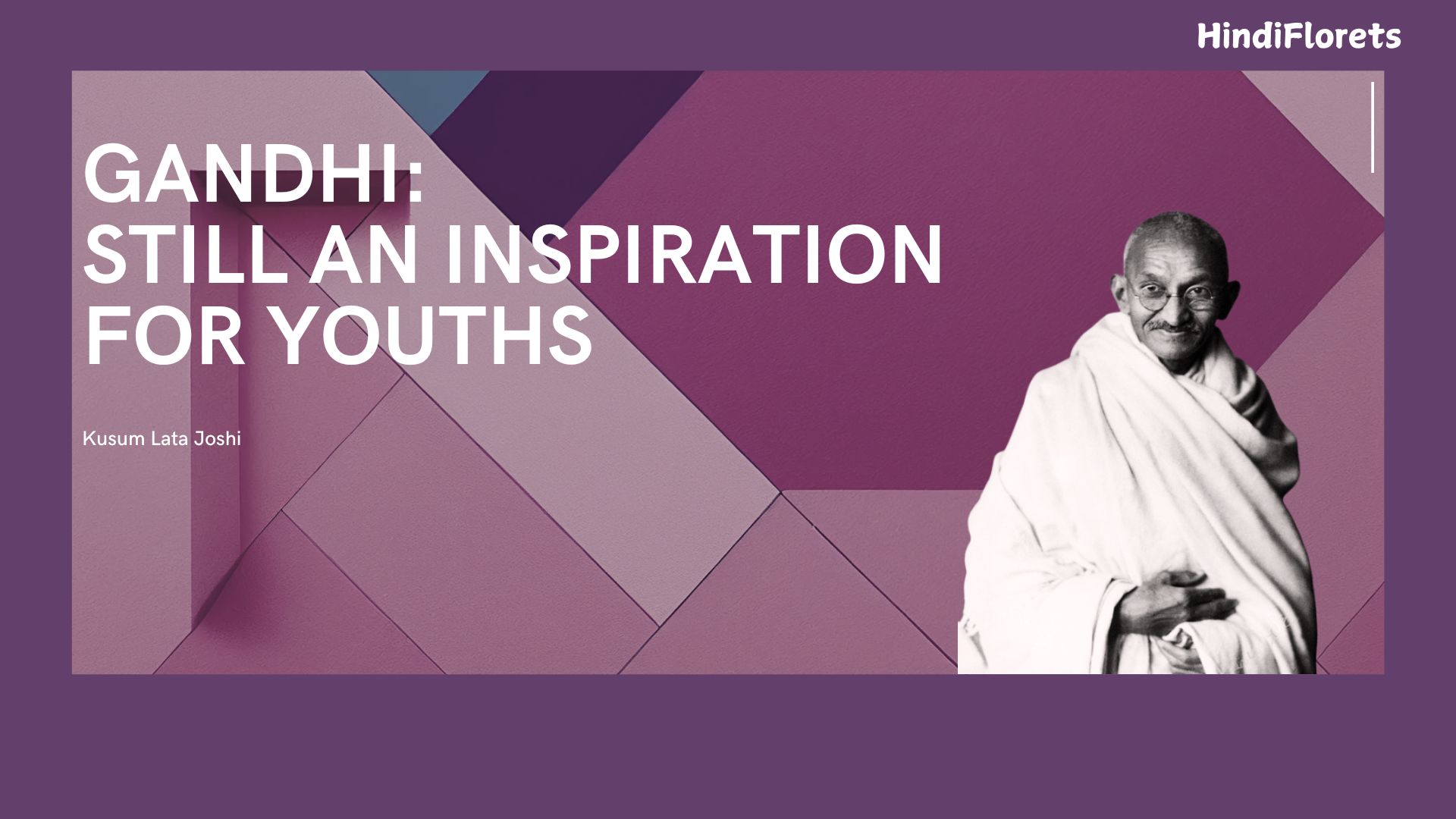
GANDHI:STILL AN INSPIRATION FOR YOUTHS
Mahatma Gandhi, one of the most revered leaders in history, left an indelible mark not only on India’s struggle for independence but also on the global consciousness of justice, peace, and nonviolent resistance. Decades after his assassination, his teachings remain profoundly relevant, particularly for the youth of today. In a world filled with complexity, polarization, and conflict, Gandhi’s ideals continue to inspire young people to take action for social justice, fight for the truth, and strive toward a more equitable society.

Gandhi’s Principles and Their Relevance to Youth Today
At the core of Gandhi’s philosophy were the values of truth (Satya) and nonviolence (Ahimsa). These principles, deeply rooted in ancient Indian spiritual traditions, became the foundation of his approach to both personal life and social activism. Gandhi’s idea of Satyagraha, or “holding firmly to truth,” not only brought freedom to India but also became a guiding light for many global movements, including the American Civil Rights Movement led by Martin Luther King Jr. and the anti-apartheid struggle in South Africa.
For the youth of today, who face an increasingly divided world, Gandhi’s call for peaceful resistance and the pursuit of truth has never been more pertinent. Whether it’s the fight against climate change, social inequalities, or human rights violations, young people are increasingly turning to nonviolent methods to make their voices heard. Gandhi’s principles remind us that real change can be achieved without violence, and that moral courage often triumphs over brute force.
Nonviolent Resistance: A Strategy for Change
One of Gandhi’s most significant contributions to political thought and activism was his commitment to nonviolent resistance. In a world that often resorts to violence to resolve conflicts, Gandhi proved that peaceful protests could topple the mightiest of empires. His Salt March of 1930, a peaceful protest against the British monopoly on salt production, was a powerful act of civil disobedience that galvanized millions of Indians. This act, though simple in its execution, carried deep symbolic meaning: it showed that even the smallest acts of defiance could be used to resist oppression.
Today’s youth are using similar strategies of nonviolent resistance to address some of the world’s most pressing challenges. From climate activists like Greta Thunberg, who leads peaceful protests demanding climate action, to the Black Lives Matter movement, which uses nonviolent demonstrations to fight racial injustice, young people around the world are embracing Gandhi’s methods. Nonviolent resistance, as Gandhi taught, is not passive; it is an active form of engagement that requires great strength, patience, and the willingness to suffer for the cause of justice.
Truth and Integrity in a Post-Truth World
Gandhi’s commitment to truth was absolute. He believed that truth was God, and that the pursuit of truth was the highest form of worship. This shows his true believe in Sanatan Dharma, which says,” SATYAM PARAM DHIMAHI”. In his personal life, Gandhi continually strived to align his actions with his values, emphasizing the importance of integrity and transparency. In an era where misinformation, fake news, and political propaganda are rampant, Gandhi’s unwavering dedication to truth offers a powerful lesson for the youth.
The information age has brought unprecedented access to knowledge, but it has also created a culture where the lines between truth and falsehood are increasingly blurred. For young people navigating this landscape, Gandhi’s emphasis on truthfulness serves as a moral compass. His life teaches us that truth is not just about facts; it’s about living in a way that is honest, ethical, and in harmony with one’s principles. In a world where it’s easy to be swayed by external pressures, Gandhi’s example encourages youth to stand firm in their convictions and to seek truth in all aspects of life.
Simplicity and Sustainability: Lessons for Today’s Youth
Gandhi’s lifestyle was a testament to the power of simplicity. He lived with minimal possessions, wore simple clothing, and embraced self-reliance, famously spinning his own clothes using a charkha (spinning wheel). For Gandhi, simplicity was not just an aesthetic choice; it was a form of resistance against the materialism and consumerism of colonial powers. His message of living simply and in harmony with nature resonates deeply with today’s environmental movement.
In a time when overconsumption and waste are driving climate change, Gandhi’s teachings on simplicity and sustainability offer a blueprint for a more balanced way of living. Young people, in particular, are at the forefront of advocating for sustainable practices, reducing their carbon footprints, and challenging the excesses of consumer culture. By living simply, Gandhi demonstrated that true freedom and fulfillment come not from material wealth but from living in alignment with one’s values and with the natural world.
Leadership Through Service
Gandhi believed in the concept of Sarvodaya – the upliftment of all. His leadership was not about power but about service to others. He often said, “The best way to find yourself is to lose yourself in the service of others.” For Gandhi, leadership was about empowering others and ensuring that even the most marginalized members of society had a voice.
This concept of servant leadership is incredibly relevant for young people today. Many youth-led movements are driven by a sense of social responsibility and a desire to create a more inclusive world. From volunteering in community service projects to leading social justice initiatives, young people are embodying Gandhi’s ideal of leadership through service. In a time when traditional hierarchies and power structures are being questioned, Gandhi’s model of servant leadership provides a refreshing alternative.
The present Prime Minister of India, Mr. Modi’s tagline “Sabka saath, sabka Vikas” is based on the same concept and another way of following Sarvodaya.
Courage and Resilience in the Face of Adversity
Gandhi’s life was marked by immense challenges, yet he remained steadfast in his commitment to his principles. Whether it was enduring imprisonment, facing opposition from both the British authorities and some segments of Indian society, or dealing with personal hardships, Gandhi’s resilience was extraordinary. He believed that true courage was not the absence of fear, but the ability to act in accordance with one’s values despite fear.
For young people today, who often face challenges like political instability, social inequality, and economic uncertainty, Gandhi’s resilience is a source of inspiration. His life teaches that setbacks are inevitable, but they can be overcome through perseverance, moral conviction, and a deep sense of purpose. Gandhi’s courage in the face of adversity encourages youth to stay committed to their ideals, even when the path is difficult.
Conclusion: Gandhi’s Enduring Legacy
Mahatma Gandhi’s life and teachings continue to inspire millions of people across the globe, and his legacy is particularly powerful for today’s youth. In a world grappling with inequality, violence, environmental degradation, and misinformation, Gandhi’s principles of nonviolence, truth, simplicity, and service offer a timeless guide for creating positive change.
As young people take up the mantle of leadership in their communities and on the global stage, Gandhi’s example serves as a reminder that true power lies not in domination or aggression but in compassion, integrity, and the willingness to stand up for what is right. His life demonstrates that even one individual, armed with moral conviction and a commitment to nonviolence, can change the course of history.
Gandhi’s call for nonviolent resistance, his insistence on living truthfully, and his vision of a more just and inclusive world remain as relevant today as they were during his lifetime. For the youth, who are often the catalysts for social transformation, Gandhi’s life stands as a beacon of hope, reminding them that they, too, can be agents of change in a world that desperately needs it.
***********


Leave a Reply